Why Mobile App Cost Estimates Are Useless Without Context
Ask three agencies how much a mobile app costs and you will get three very different answers. The honest answer is: it depends entirely on what you are building, how complex it is, who builds it, and where they are based.
This guide does not give you a single number. It gives you a framework for understanding what drives cost — and what questions to ask any agency before taking their estimate seriously.
The Main Cost Drivers
App Type and Complexity
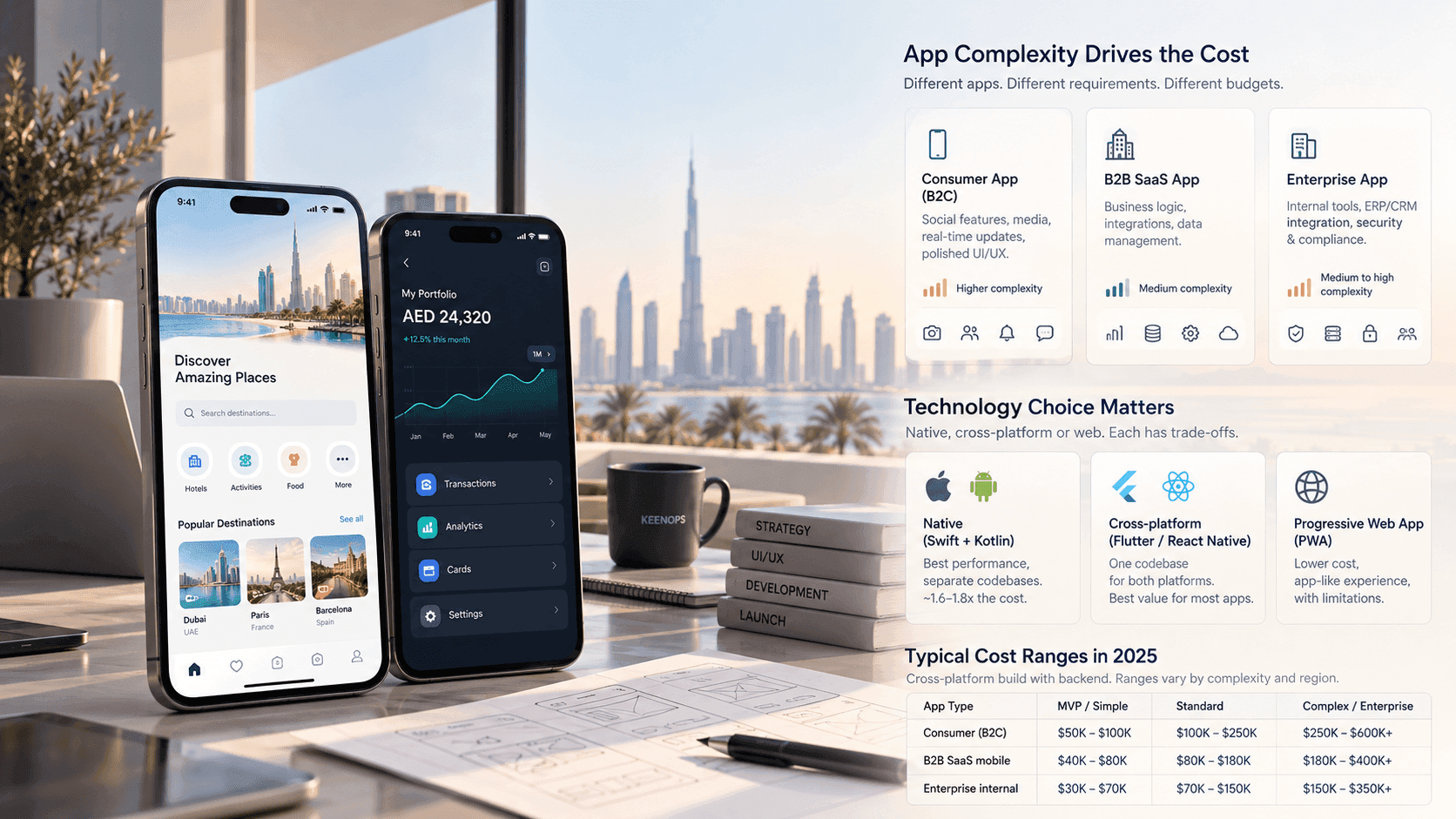
Consumer apps (B2C): Social features, push notifications, media handling, real-time updates, and the expectation of a polished UI/UX make consumer apps expensive to build well. Simple informational apps with 5–10 screens sit at the lower end; complex social or marketplace apps with deep feature sets sit at the high end.
B2B SaaS mobile apps: Often simpler in visual design but complex in business logic, integrations, and data management. The complexity lives in the backend and API layer.
Enterprise internal apps: Typically lower visual polish requirements but complex integration needs (ERP, CRM, LDAP/SSO, offline sync). Security and compliance requirements add significant cost.
Native vs. Cross-Platform
Native (Swift for iOS, Kotlin for Android): Best performance, best platform integration, but requires two separate codebases — roughly 1.6–1.8x the cost of a single cross-platform codebase.
Cross-platform (React Native, Flutter): One codebase for both platforms. Significant cost reduction for most apps. Performance is near-native for most use cases. The right choice for 80% of mobile app projects.
Progressive Web App (PWA): Web technology delivered as an app-like experience. Much lower cost than native or cross-platform, but with limitations on device hardware access, background tasks, and app store distribution.
Team Model
- In-house team: Highest quality control, highest total cost (salaries, benefits, management overhead). Only justified for long-term, complex product development.
- Local agency (UAE or European market): Higher day rates but timezone alignment, local market knowledge, and face-to-face collaboration. Rates: AED 600–1,200/hour in Dubai; €80–180/hour in Western Europe.
- Nearshore agency: Eastern European, North African, or South Asian teams working in European timezones. Good quality-cost balance. Rates: €35–80/hour.
- Offshore agency: Significant cost reduction (rates of $15–40/hour common) but higher coordination overhead, quality variance, and risk of hidden costs from misaligned requirements.
Cost Ranges by App Type (2025)
| App Type | MVP / Simple | Standard | Complex / Enterprise |
|---|---|---|---|
| Consumer (B2C) | $50K–$100K | $100K–$250K | $250K–$600K+ |
| B2B SaaS mobile | $40K–$80K | $80K–$180K | $180K–$400K+ |
| Enterprise internal | $30K–$70K | $70K–$150K | $150K–$350K+ |
These ranges assume a cross-platform React Native or Flutter build with a backend API. Native (iOS + Android separately) typically adds 40–60%.
UAE context: Local Dubai agency rates sit at the top of these ranges. Many UAE businesses successfully use nearshore or offshore teams with KEENOPS providing independent technical oversight — getting the cost efficiency of offshore development without the quality and governance risks.
European context: Western European in-house builds typically run 30–50% above these ranges. Nearshore Eastern European teams typically run 20–40% below.
What Is (and Is Not) Included
Most agency quotes include: requirements, design, development, testing, and initial deployment. They typically exclude: app store fees, backend infrastructure costs (AWS, GCP), third-party API costs, post-launch maintenance, and future feature development.
For a realistic 12-month total cost of ownership, add 30–40% to the development quote.
How to Get an Accurate Estimate
The quality of an estimate depends entirely on the quality of the brief. Before requesting quotes:
- Write a detailed product requirements document (even a rough one) — agencies cannot accurately estimate what they do not understand
- Define the platforms (iOS, Android, both), tech approach (native/cross-platform), and backend requirements
- Specify any integrations (payment gateways, third-party APIs, existing systems)
- Indicate your timeline constraints — rush timelines significantly increase cost
- Ask for a breakdown by phase (design, frontend, backend, QA, deployment) not just a total number