The Expensive Mistake Most Founders Make
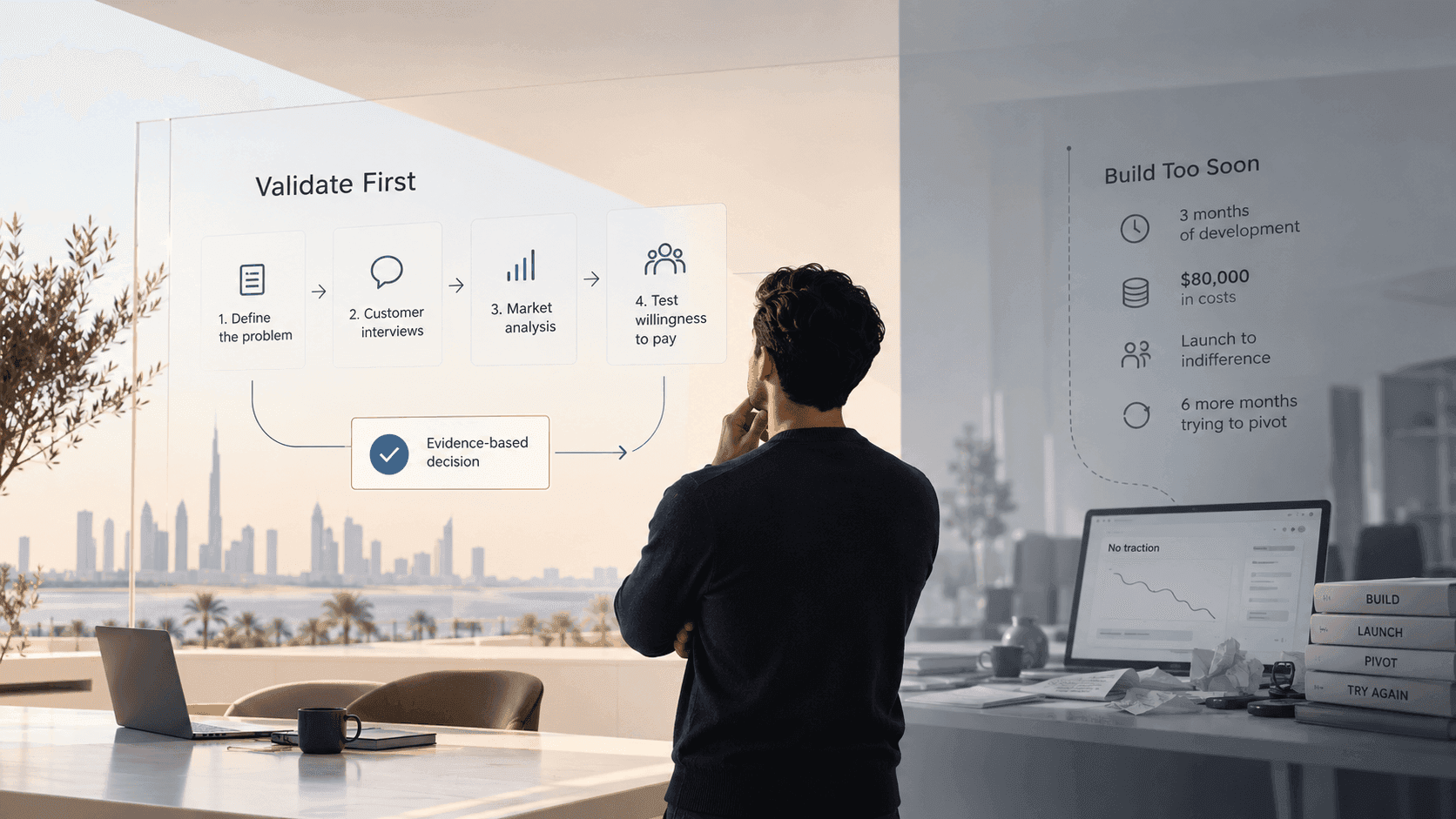
The most common and most expensive mistake in the startup world is building before validating. A founding team spends three months and $80,000 building a product, launches to indifference, and then spends another six months trying to pivot the product to fit a market that was never properly understood.
Validation is not about proving you are right. It is about finding out how you are wrong — cheaply, quickly, and before you have committed significant capital and time.
What Validation Actually Tests
Before building anything, you should have confident answers to three questions:
- Is the problem real? Do real people experience this problem with sufficient frequency and pain to pay for a solution?
- Is the market real? Are there enough of these people — with budget to spend — to build a business worth building?
- Is your solution right? Of all the ways to solve this problem, does your proposed approach resonate with the people who have it?
Many founders can answer question 3 with some confidence because they have spent months thinking about their solution. Far fewer have genuinely tested questions 1 and 2.
The 8-Step Validation Framework
Step 1: Define the Problem With Precision
Write a one-paragraph problem statement from the perspective of the person experiencing it. Not your solution, not your vision — the problem. If you cannot write this paragraph without mentioning your product, you are solution-first rather than problem-first.
Good: "Mid-sized logistics companies in the UAE spend 3–5 hours per week manually reconciling fuel receipts across a fleet of 20+ vehicles, with errors that create accounting delays and disputes with drivers."
Poor: "There is no good fleet management software in the UAE."
Step 2: Identify Your Riskiest Assumption
Every startup idea rests on a hierarchy of assumptions. Find the one that, if false, invalidates everything else. This is your primary validation target.
Common risky assumptions: that the problem is frequent enough to pay to solve, that the buyer has budget allocated, that the decision-maker can actually purchase without a lengthy procurement process, or that users will change an existing behavior.
Step 3: Map the Existing Solutions
How do people solve this problem today? Spreadsheets, manual processes, competitors, workarounds? If the answer is "nothing," that is a serious red flag — it usually means either the problem is not painful enough to solve or the market is too small to have attracted solutions.
Step 4: Conduct 15 Customer Discovery Interviews
Talk to 15 people who match your target persona — not to pitch, to listen. Ask about the problem, how they currently solve it, what it costs them, what they have tried before, and what good would look like.
Five insights from 15 genuine interviews are worth more than five weeks of desk research. Patterns across these conversations will tell you whether your assumptions hold, what you misunderstood, and what opportunities you did not see.
Step 5: Define the Market Size Honestly
Total Addressable Market (TAM) is not a number you want to inflate for investor slides — it is a reality check on whether the business is worth building. Estimate:
- How many customers fit your target profile?
- What would a realistic annual contract value be?
- What market penetration is achievable in 3 years?
If the realistic math produces a $2M revenue ceiling, that is not a venture-fundable business — and you need to know that before building.
Step 6: Test Willingness to Pay
Most founders validate that people like their idea. Very few validate willingness to pay. The question is not "would you use this?" — it is "would you pay €50/month for this? Why? What would have to be true for you to sign up today?"
The most direct test: ask for a letter of intent, a pre-order, or a paid pilot before the product exists. If no one will commit even a nominal amount before the product is built, your confidence in paid demand should be low.
Step 7: Build the Minimum Validation Artifact
A validation artifact is not a product — it is the smallest thing that tests your riskiest assumption. This might be:
- A landing page with a sign-up form and paid ads
- A Figma prototype used in user testing sessions
- A concierge MVP where you deliver the service manually
- A pre-sale to 5 early adopters
The goal is evidence, not a product. Spend days, not months.
Step 8: Decide With Evidence
After completing steps 1–7, you should have:
- Evidence the problem is real and frequent
- Evidence the market is large enough
- Evidence people will pay
- A clear view of what to build first
If the evidence is weak on any dimension, the answer is not "build anyway and see" — it is to go back to the interviews, adjust the problem framing, or pivot to an adjacent opportunity.
The Cost of Skipping Validation
The KEENOPS Challenge Your Idea framework was built from seeing too many founders arrive with a $150,000 build request that a proper 3-week validation process would have saved entirely — or redirected toward a significantly better product definition.
Eight structured conversations and two weeks of honest testing are worth more than three months of confident building toward the wrong problem.